
The gate’s measured weight is the starting point for choosing a motor, but it is not the only factor. The right gate motor weight capacity must also account for the gate’s dimensions, wind resistance, track condition and operating frequency.
A higher motor rating may seem like the safest choice, but reliable movement depends on matching the motor to the complete installation. This guide explains how materials and dimensions affect sliding gate weight, how to estimate it and what to consider when matching capacity to your gate. In Qatar, dust, heat, coastal exposure and wind can also affect operating conditions, so the track, rollers and site environment matter alongside the weight figure. Use these factors to select a motor that moves the gate smoothly without placing avoidable strain on the automation system.
Key Takeaways
- Assess the gate’s material, dimensions, track and rollers together, since each can affect the load the motor must move.
- Use construction details to form a weight estimate, then account for cladding, supports and other features that add mass.
- Consider wind exposure, operating frequency and site conditions alongside the gate’s measured weight.
- Choose a motor suited to the full installation, rather than relying on a capacity figure alone; correct sizing helps limit unnecessary strain and wear.
What Affects Gate Weight?
For a heavy gate or one on a steep driveway, consider both its measured weight and resistance to movement. Check the slope, track condition and rolling effort: the gate’s weight alone does not describe what the motor must overcome.
Sliding Motor Capacity Ranges
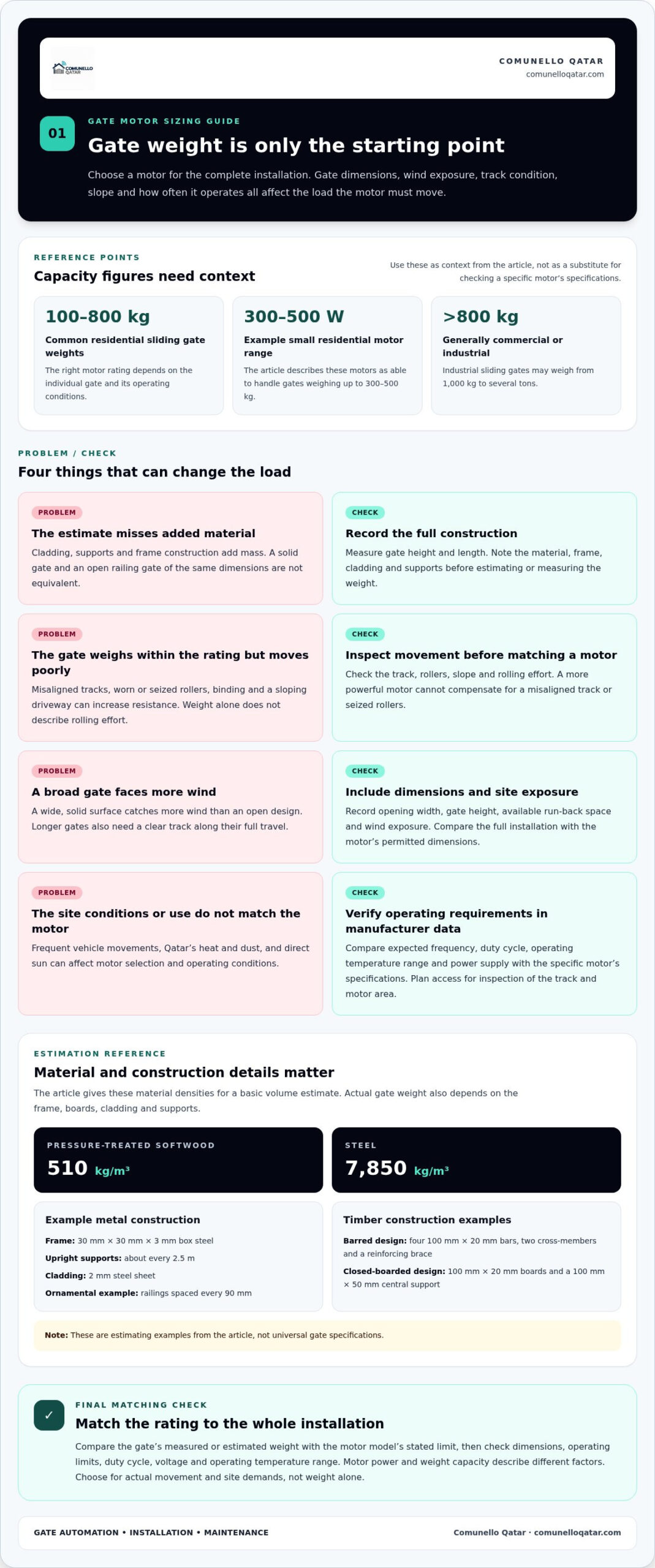
Sliding gate motor capacity ratings describe the maximum gate weight a motor is designed to move. Small residential motors rated around 300 to 500 watts can handle gates weighing up to 300 to 500 kilograms. Residential sliding gates commonly weigh between 100 and 800 kilograms, so the correct rating depends on the individual gate, not its residential label.
Compare the motor model’s stated weight limit with the gate’s measured weight. Treat the rating as a selection boundary, not a guarantee of smooth operation: track alignment and roller condition also affect resistance.
Selecting Capacity for Heavy Gates
Start by weighing the gate or estimating its mass from its construction, then assess how easily it rolls. For a heavy gate or one on a steep driveway, account for the slope and any binding along the track. A more powerful motor cannot compensate for a misaligned track or seized rollers.
Choose a rating suited to the gate’s actual operating conditions rather than defaulting to one just above its weight. In Qatar, dust can collect on exposed tracks, while wind can increase resistance on a broad gate surface.
Gates exceeding 800 kg are generally treated as commercial or industrial-grade systems. At industrial sites, warehouses and large office complexes, sliding gates can weigh from 1,000 kilograms to several tons. These installations need a robust motor selected for the gate’s mass, movement and operating demands, rather than a residential motor chosen by weight alone.
Motor power and weight capacity are related but describe different factors. Power indicates a motor’s ability to move the gate, while the gate’s weight and resistance determine the force needed for reliable travel. For a practical selection, record the gate’s weight, inspect the track and rollers, and consider slope and wind exposure before comparing motor models.
Gate dimensions and operating requirements
A sliding gate’s width and height affect its load and movement, as well as the material it is made from. A broad, solid gate catches more wind than an open design, while a longer gate needs a clear track along its full travel. Record the opening width, gate height and available run-back space before comparing motor specifications.
The motor’s operating specifications should suit the gate’s travel and daily use. Check the manufacturer’s data for permitted gate dimensions, operating limits and duty cycle, then compare them with expected use at the site. A motor serving a long opening may need different capabilities from one used at a compact residential entrance.
In Qatar, heat makes the motor’s operating temperature an important selection factor. Read the manufacturer’s stated operating range and consider where the motor will sit, including exposure to direct sun and surrounding heat. Dust around the enclosure and track can also affect the installation, so plan for protection and routine inspection access.
Match the motor’s voltage to the power supply and its marked requirements. Do not assume that motors with similar weight ratings use the same voltage. The manufacturer’s specifications identify the correct supply; installation must also account for suitable wiring and safe isolation. A remote or wall switch can trigger opening and closing, but neither changes the motor’s capacity.
Consider how the gate will be used. A residential entrance that opens occasionally has different demands from a site entrance serving frequent vehicle movements. Include opening distance, expected frequency and control method in the specification. For example, a facility using remote access and a switch should have a motor, controls and gate movement designed as one compatible system, rather than choosing a motor by weight alone.
Estimated weight by gate material, height and leaf length
Gate length and wind exposure both affect the force needed for movement. A longer sliding gate travels farther and may catch more wind, increasing resistance. Size the motor for the gate’s weight, dimensions and site exposure together.
For a first estimate, measure the gate’s height and length, then identify its material and construction. A solid metal gate contains far more material than an open railing design of equal dimensions. For a basic volume estimate, pressure-treated softwood is assumed at 510 kg/m³, while steel is 7,850 kg/m³. Actual gate weight also depends on its frame, boards, cladding and supports.
Construction assumptions can make estimates more useful. A metal box-steel gate model may use a 30 mm × 30 mm × 3 mm frame, with upright supports about every 2.5 metres and 2 mm steel sheet cladding. An ornamental steel design may instead use railings spaced every 90 mm. These are estimating examples, not universal gate specifications.
- Barred timber gate: account for four 100 mm × 20 mm bars, two cross-members and a reinforcing brace.
- Closed-boarded timber gate: include 100 mm × 20 mm boards and a 100 mm × 50 mm central support.
- Ornamental metal gate: include the frame and four cross-members made from 10 mm × 30 mm bars.
For swing gate automation, leaf length matters because a longer leaf changes the torque needed to open and close it. Consider each leaf’s weight, balance and wind exposure, then compare its dimensions with the motor manufacturer’s limits.
Select a road barrier according to boom length and application, not sliding gate weight. Choose a barrier motor specified for the boom and operating conditions. Gate length limits also depend on the chosen motor’s specifications. During installation, confirm that the track or rollers move freely, since resistance can affect movement even when the estimated weight seems suitable.
Matching motor capacity to gate weight
Match the motor’s rated limit to the gate’s measured weight, then account for resistance and operating conditions. Sliding motors are generally rated for the complete gate, while swing motors must also suit each leaf’s weight, balance and length. These ratings are not interchangeable.
For example, a listed sliding motor rated for 1,000 kg has a 400 W power rating. Other market examples include sliding motors specified for 400 kg or 3,000 kg. Treat these figures as model-specific ratings, not as a universal rule linking wattage to capacity.
Some swing motor specifications use a maximum weight per leaf, with one electromechanical gear motor listing 700 kg per leaf. For a dual-leaf gate, assess each leaf and its movement rather than simply dividing the combined weight. Leaf length and balance affect the torque needed to open and close it.
There’s no single extra-capacity percentage that suits every installation. If the estimated gate weight approaches a motor category’s upper limit, select a higher-capacity category, then check the manufacturer’s limits for dimensions and use. A 200 to 300 kg motor may suit a smaller, lighter residential gate; a larger steel front-yard gate may require 500 to 800 kg capacity.
- Compare like with like: use total gate weight for sliding systems and each leaf’s weight for swing systems.
- Check the complete rating: confirm gate dimensions and operating demands against the motor’s specifications.
- Correct the mechanics: resolve binding or poor movement before increasing motor capacity.
An undersized motor may overheat or malfunction, while an oversized unit can strain the gate and track. Proper sizing supports smooth movement, but maximum capacity is not the only selection criterion. For a dual gate, consider the overall weight and size while ensuring each motor is suited to its own leaf.
Use the gate motor weight capacity as one part of your selection, alongside the gate’s dimensions and operating demands. For help applying those criteria to your installation, request a gate automation quotation.
Comunello Qatar: Comunello Fort 1500kg Sliding Gate Motor
Comunello Fort 1500kg Sliding Gate Motor gives Qatar property owners a named option for sliding gates whose assessed weight fits its 1500 kg capacity class. Before selection, compare the gate’s measured weight and dimensions with the motor’s specifications, and account for track condition, wind exposure and operating demands.
Correct sizing also depends on proper installation and commissioning. A suitable motor cannot resolve a binding track or poorly moving gate, so the complete system should be assessed before automation is selected. For swing gates, Comunello Qatar also offers the RAM 300 230V, Abacus 300 230V and Proteco swing gate motors, which address a different gate configuration.
Contact Comunello Qatar to discuss the gate and motor selection, or visit comunelloqatar.com.
Plan the Right Automation for Your Entrance
Before selecting equipment, define how the entrance needs to function each day. Consider the access pattern, site exposure and any existing controls. This gives homeowners, facility managers and project teams a practical basis for evaluating suitable automation.
For a property in Doha, Dafna, West Bay or The Pearl, gate motor weight capacity is one part of a wider selection decision. The entrance layout and control requirements also shape the system, while local conditions affect the installation. Consider these factors together rather than treating the motor rating as the sole measure of suitability.
Good planning starts with a clear understanding of the site and its daily use. Once those requirements are defined, property owners and project teams can compare suitable automation options with greater clarity.
أسئلة متكررة
What gate weight can common sliding gate motors handle?
There is no single weight limit for all sliding gate motors; the permitted load depends on the model. For a replacement, identify the existing motor’s exact model and compare its manufacturer rating with the gate’s current condition. Added cladding or later modifications can make an old estimate unreliable, so assess the gate in its present configuration.
What gate weight can common swing gate openers handle?
Swing opener limits vary by model, and the stated rating must suit the operator’s installation arrangement. Check the manufacturer’s specifications for the exact actuator and mounting layout, including permitted gate dimensions. A capacity figure for another operator or arm configuration may not apply, even if both products are designed for swing gates.
How do you calculate the weight of a gate?
For an existing gate, the most direct option is to weigh it using suitable lifting and weighing equipment. For a gate that has not yet been built, use its assembled mass from the fabrication schedule rather than relying only on a general material estimate. Include later additions in the final figure, as modifications can change the load on the automation.
What are the risks of using an undersized gate motor?
An undersized motor can struggle to complete the gate’s travel reliably and may malfunction under repeated strain. If movement becomes inconsistent, note whether the gate stalls at startup, mid-travel or near closing. This pattern gives a technician useful diagnostic context and can help distinguish a sizing issue from a fault elsewhere in the gate automation system.
